Skip to content
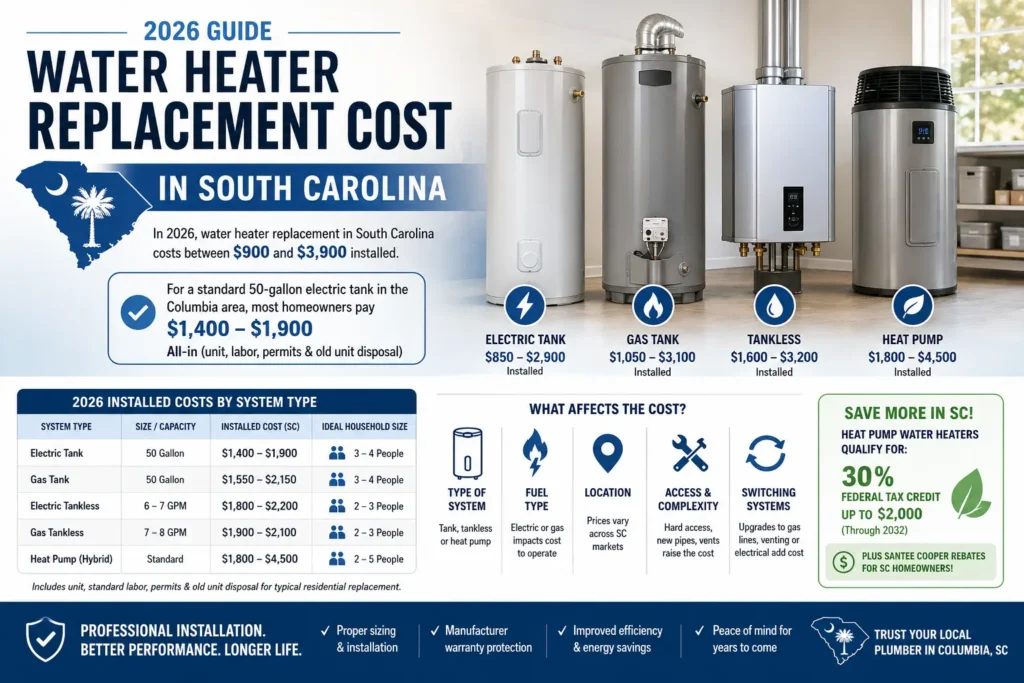
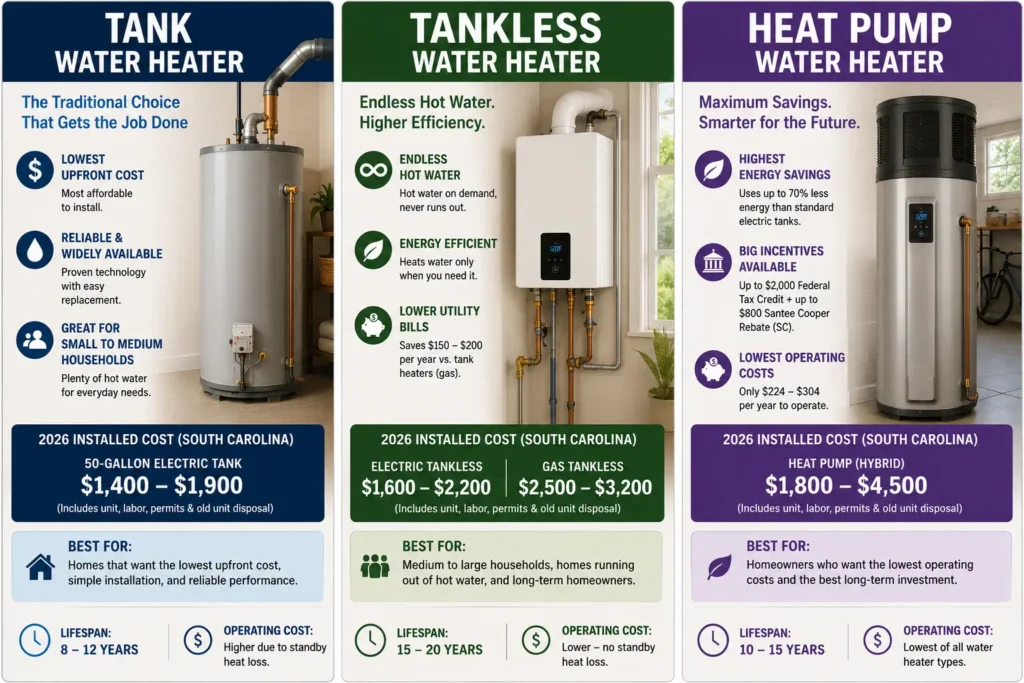
A water heater replacement in South Carolina costs between $900 and $3,900 in 2026, all in. For a standard 50-gallon electric tank in the Columbia area, most homeowners land between $1,400 and $1,900 when you include the unit, labor, permits, and old unit disposal. Gas tankless upgrades push into the $2,500 to $3,200 range.
That is the direct answer. The rest of this guide breaks down every cost factor, gives you a clear pricing table by system type, explains what competitors miss, and wraps up with the most commonly asked questions South Carolina homeowners have before calling a plumber in Columbia, SC.
2026 Water Heater Price Table for South Carolina
The table below covers the real 2026 installed costs for every major water heater type and size in South Carolina. Each figure includes the unit, standard labor, permit fees, and old unit disposal for a typical residential replacement, cross-referenced from multiple local and national sources.
| Water Heater Type | Size / Capacity | Equipment Only (SC) | Installed Cost SC (2026) | Ideal Household Size |
| Electric Tank | 20 gallon | $400 to $800 | $850 to $1,250 | 1 person |
| Electric Tank | 30 gallon | $500 to $900 | $950 to $1,350 | 1 to 2 people |
| Electric Tank | 40 gallon | $700 to $1,000 | $1,150 to $1,550 | 2 to 3 people |
| Electric Tank | 50 gallon | $900 to $1,400 | $1,400 to $1,900 | 3 to 4 people |
| Electric Tank | 60 gallon | $1,100 to $1,700 | $1,600 to $2,200 | 4 to 5 people |
| Electric Tank | 80 gallon | $1,600 to $2,200 | $2,100 to $2,900 | 5 to 6 people |
| Gas Tank | 30 gallon | $600 to $1,000 | $1,050 to $1,550 | 1 to 2 people |
| Gas Tank | 40 gallon | $700 to $1,100 | $1,300 to $1,850 | 2 to 3 people |
| Gas Tank | 50 gallon | $900 to $1,600 | $1,550 to $2,150 | 3 to 4 people |
| Gas Tank | 60 gallon | $1,100 to $1,900 | $1,800 to $2,500 | 4 to 5 people |
| Gas Tank | 80 gallon | $1,700 to $2,300 | $2,300 to $3,100 | 5 to 6 people |
| Electric Tankless | 4 to 5 GPM | $300 to $700 | $1,600 to $1,700 | 1 to 2 people |
| Electric Tankless | 6 to 7 GPM | $500 to $1,000 | $1,800 to $2,200 | 2 to 3 people |
| Gas Tankless | 5 to 6 GPM | $800 to $1,500 | $1,600 to $1,800 | 1 to 2 people |
| Gas Tankless | 7 to 8 GPM | $1,000 to $1,800 | $1,900 to $2,100 | 2 to 3 people |
| Gas Tankless | 9 to 10 GPM | $1,200 to $2,000 | $2,200 to $2,600 | 3 to 4 people |
| Gas Tankless | 10 to 11 GPM | $1,500 to $2,000 | $2,500 to $3,200 | 4 to 5 people |
| Heat Pump (Hybrid) | Standard residential | $1,000 to $2,500 | $1,800 to $4,500 | 2 to 5 people |
Equipment-only prices (no labor) run roughly $400 to $2,300 for tank units and $300 to $3,000 for tankless systems, depending on brand, capacity, and fuel type.
Understanding What Drives the Price in SC
Knowing these price ranges is useful. Knowing what pushes your number toward the high or low end is more useful.
Type of System
While tank heaters are cheaper to install, they cost more to run because the large tank maintains a constant temperature even when no hot water is being used, resulting in standby heat loss and wasted energy. Tankless systems eliminate that, which is why they carry a higher upfront cost but deliver measurable long-term savings.
Fuel Type
Gas units cost more at the equipment level but carry lower monthly operating costs in most SC households. The average South Carolina home spends around $128 per month on electricity and $62 on natural gas, which helps illustrate why switching to gas for water heating can lower your utility bills noticeably over time.
Location in South Carolina
Labor rates vary between markets. Columbia, Charleston, and Greenville carry slightly higher labor costs than smaller cities like Sumter or Florence. In Rock Hill, SC, the average water heater installation runs $1,335 with a typical range of $458 to $1,975. Urban Columbia and Charleston markets trend toward the higher end of that range.
Access and Installation Complexity
Difficult installations in cramped spaces like closets or crawl spaces add $125 to $300 per labor hour. Running new pipes from the heater to fixtures costs around $12 to $15 per linear foot, and venting upgrades for gas units can add $500 to $1,500 if installing vents for the first time.
Switching System Types
Converting from a tank to a tankless unit involves more work than a straight swap. Converting from tank to tankless often requires gas line resizing, venting changes, or electrical upgrades, which increases the total cost considerably. Always ask your plumber for a written breakdown before committing.
Tank vs. Tankless vs. Heat Pump: Which One Makes Sense for You?
Each system type has a clear use case. Here is how to think about it.
Traditional Tank Water Heater
This is the most affordable path if you need a straightforward replacement and want the lowest upfront cost. It works best for smaller households, older homes where infrastructure is already in place, and homeowners who plan to sell within the next several years. Tank water heaters last 8 to 12 years on average, and their lifespan can be extended to 15 years with proper maintenance, including annual flushing.
Tankless (On-Demand) Water Heater
Tankless makes the most sense for larger families who run out of hot water regularly, homeowners planning to stay long-term, and anyone looking to reduce monthly energy costs. Gas tankless water heaters save $150 to $200 annually compared to standard 50-gallon gas tanks by eliminating standby heat loss and operating at higher efficiency ratings. Over a 15-to-20-year lifespan, that adds up to $2,250 to $4,000 in energy savings.
Heat Pump (Hybrid) Water Heater
This is the best long-term investment for most South Carolina homeowners, specifically because of the financial incentives available right now. Heat pump water heaters qualify for a 30 percent federal tax credit of up to $2,000 under the Inflation Reduction Act, valid through 2032. This is a credit, not a deduction, meaning it reduces what you owe dollar for dollar. Stack that with the Santee Cooper rebate program for SC homeowners, and the net cost drops substantially. Heat pump water heaters deliver the lowest operating costs of any type at $224 to $304 per year, compared to $610 to $720 annually for a standard electric tank, representing 60 to 70 percent in savings.
Additional Cost Line Items SC Homeowners Often Overlook
Most online guides stop at unit and labor. Here are the additional costs that show up in real SC quotes.
Permit Fees: Required in Columbia and virtually every South Carolina jurisdiction. Columbia follows the 2021 South Carolina Plumbing Code, which mandates permits for water heater replacements to ensure safety standards are met. Permit fees typically run $50 to $200.
Old Unit Disposal: Plan for $50 to $150 for haul-away. Always confirm upfront whether this is included in your quote.
Expansion Tank: Many SC jurisdictions now require a thermal expansion tank when a pressure-reducing valve is present. This add-on runs $100 to $200 installed.
Venting Upgrades: Gas water heaters need adequate venting. Replacing existing vents costs $100 to $600, and installing vents for the first time adds $500 to $1,500 to the project.
Emergency Service Premium: A Saturday morning failure will cost more than a planned weekday replacement. Emergency and after-hours service fees typically add $150 to $300 on top of standard rates.
Repair vs. Replace: The 50% Rule
Not every failing water heater needs to be replaced. The plumbing industry uses a simple benchmark: if the cost of repair is more than 50 percent of the cost of a new water heater, replacement is usually the better option.
Common repair costs in the South Carolina market:
Thermostat or heating element replacement on an electric unit: $150 to $300. Temperature and pressure relief valve replacement: $100 to $200. Anode rod replacement to slow corrosion: $150 to $250. Tank flush and descaling for sediment buildup: $100 to $200.
For most typical repairs, homeowners are spending between $150 and $700, with labor running $75 to $150 per hour and most repairs taking one to three hours.
If your unit is under eight years old and the repair is a single isolated issue, fixing it makes financial sense. If it is over ten years old, showing multiple symptoms, and the repair estimate is approaching half the cost of replacement, a licensed plumber in Columbia, SC, will almost always recommend moving on.
Signs You Need a New Water Heater Right Now
Do not wait for a flood in your utility room to act. These are the clear indicators that it is time to call a plumber.
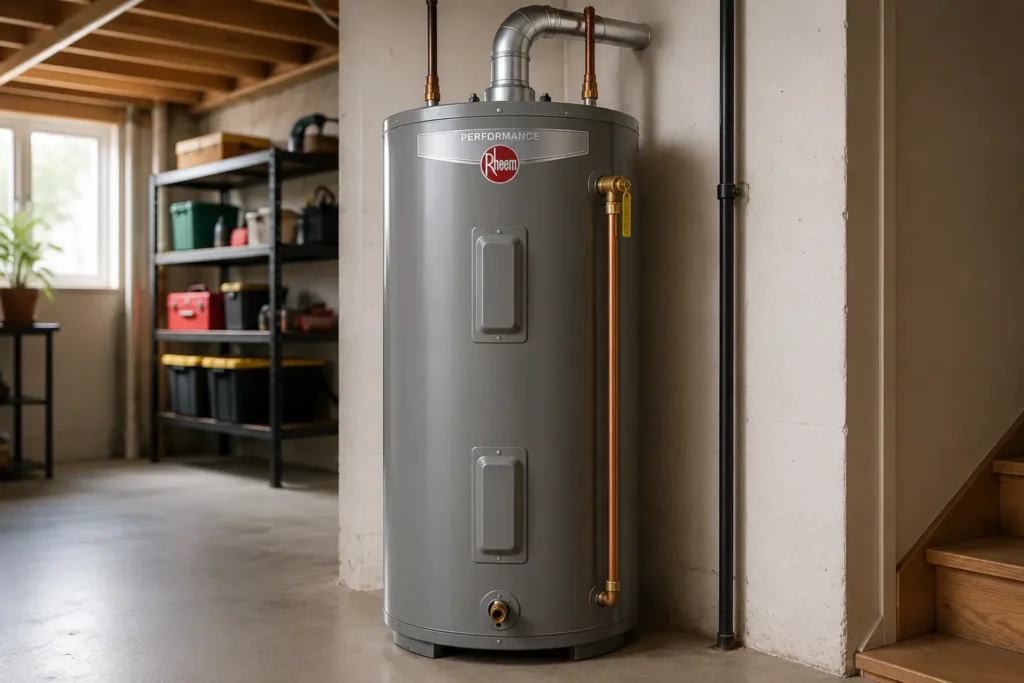
Your unit is over 10 to 12 years old, and efficiency has visibly declined. Hot water runs out faster than it used to, despite no change in household habits. You are hearing rumbling, popping, or banging sounds from the tank, which point to heavy sediment buildup at the bottom. Hot water from your taps is running rust-colored or discolored, indicating internal corrosion. There is visible moisture or pooling water around the base of the unit. Hard water is common throughout Irmo, Chapin, and Lexington, and the mineral buildup it causes can shorten a water heater’s lifespan by several years. If you are in a hard-water area of the Midlands, these symptoms can arrive earlier than the 10-year average.
How Long Does Water Heater Installation Take in SC?
This is a question most guides skip, but homeowners ask it constantly because they need to plan their day around the job.
Installing a tank water heater takes 2 to 6 hours, depending on how easy the unit is to access. Tankless water heater installation is more complex and takes up to 10 hours for a new installation, with same-for-same replacements being faster than retrofit installations.
For a standard like-for-like electric tank swap in a straightforward location, a licensed plumber in Columbia SC, will typically have hot water flowing again within two to four hours.
Why a Licensed Plumber in Columbia, SC, Is the Only Option
Only licensed plumbing contractors or master plumbers holding a valid South Carolina LLR license may perform or supervise water heater installation as plumbing work in the state.
Proceeding with a water heater replacement without a permit is illegal in South Carolina. Skipping the permit could result in hefty fines and void your homeowner’s insurance.
Beyond legal compliance, a licensed plumber brings liability insurance, manufacturer warranty protection, and the expertise to catch problems before they become expensive surprises. The $50 to $150 you might save hiring an unlicensed handyman is not worth the exposure when you are dealing with pressurized water lines, gas connections, or high-voltage electrical systems.
How to Lower Your Water Heater Cost in SC in 2026
There are real, legitimate ways to reduce what you pay without compromising the quality of the work.
Collect at least three written quotes before choosing a contractor. Labor rates vary 20 to 40 percent between contractors in the same city, so always confirm that each quote includes permits, haul-away, and code upgrades before comparing numbers.
Claim your federal tax credit if upgrading to a heat pump unit. The 30 percent credit up to $2,000 is available through 2032 and can dramatically change the math on a higher-efficiency system.
Check your SC utility provider for rebates. Santee Cooper, Duke Energy Progress, and Dominion Energy South Carolina all run rebate programs for qualifying energy-efficient upgrades installed by licensed SC plumbing contractors.
Schedule during off-peak times. Some contractors charge more for weekend or after-hours service. A weekday replacement during regular hours is almost always the most affordable option.
Buy the unit separately if possible. Purchasing directly from a home improvement retailer and hiring a licensed plumber for labor only can shave $100 to $300 off the total project cost.
Frequently Asked Questions: Water Heater Costs in SC
Q1: What is the average cost to replace a water heater in Columbia, SC, in 2026?
Most Columbia homeowners pay $1,400 to $1,900 for a standard 50-gallon electric tank replacement, including the unit, labor, permit, and old unit removal. Gas units and tankless systems cost more. Getting three quotes from licensed plumbers in Columbia, SC, ensures you land at a fair price for your specific setup.
Q2: Is it cheaper to repair or replace a water heater in South Carolina?
As a general rule, if your unit is more than 10 years old and the repair cost is more than half the price of a new one, replacement usually makes more sense financially. For newer units with a single isolated problem, repair is almost always the smarter call. A licensed plumber can give you an honest assessment on the spot.
Q3: Do I legally need a permit to replace my water heater in SC?
Yes. Even direct like-for-like replacements require a permit in most South Carolina jurisdictions because the replacement may involve updated venting, updated temperature and pressure discharge routing, or the addition of a thermal expansion tank. A licensed plumber handles the permit application as part of the job.
Q4: How long does a water heater last in South Carolina?
Traditional tank water heaters typically last 8 to 12 years, while tankless water heaters can last 15 to 20 years or more with proper maintenance. Hard water in areas like Lexington, Irmo, and Chapin can shorten that lifespan, so annual flushing and anode rod inspections are worth doing.
Q5: Is a tankless water heater worth it in SC?
For most homeowners planning to stay in their home for seven or more years, yes. While the initial cost is higher than traditional tank units, the benefits include lower energy bills, endless hot water for multiple simultaneous uses, and a compact space-saving design. The energy savings alone recoup the higher upfront cost within five to eight years for most SC households.
Q6: Are there rebates or tax credits available for water heaters in SC?
Yes, and they are worth pursuing seriously. Heat pump water heaters qualify for a 30 percent federal tax credit up to $2,000 through the Inflation Reduction Act. Santee Cooper and other South Carolina utility providers offer additional rebates for qualifying installations performed by a licensed SC plumbing contractor. Stacking both incentives can reduce your net out-of-pocket cost by $1,000 to $2,000.
Q7: Can I install a water heater myself in South Carolina to save money?
Technically, some jurisdictions allow owner-occupied exemptions, but handling high-voltage electrical systems and gas line connections yourself puts you at real risk of electrocution, fire, or gas exposure, and an improper installation can void your homeowner’s insurance and expose you to significant fines. The labor cost savings rarely justify the financial and safety risks.
Ready to Get Your Hot Water Back?
Whether your water heater is on its last legs or you just want an honest quote before it becomes an emergency, our licensed team is ready to help. We serve Columbia, Lexington, Irmo, Chapin, Cayce, and the entire Midlands area with same-day availability and upfront pricing, no surprises.
Visit our Website: https://plumbercolumbiasc.com/