Skip to content
You wake up at 2:00 AM to the sound of running water. Not rain. Not a dream. You walk downstairs and feel a wet spot spreading across your hardwood floor. Your heart pounds. Do you call someone now, or can it wait until morning?
This scenario plays out hundreds of times each year in Columbia, South Carolina homes. From the historic neighborhoods of Shandon to the growing communities of Northeast Columbia, homeowners face the same difficult question: When is a plumbing problem a true emergency?
Calling an emergency plumber isn’t cheap. No one wants to pay a weekend trip fee for a dripping faucet. But waiting too long on a real emergency can cost you ten times more in water damage, mold remediation, and structural repairs.
This guide is written specifically for Columbia SC homeowners, renters, property managers, and business owners. You’ll learn exactly what qualifies as a plumbing emergency, how to respond before help arrives, and how to avoid the most common local plumbing disasters—including the ones that spike every winter when temperatures drop below freezing in the Midlands.
Let’s get one thing clear from the start: When in doubt, call. A reputable emergency plumber will tell you if it can wait. That phone call could save your home.
What Is Considered a Plumbing Emergency?
A plumbing emergency is any situation where delaying action for more than one to two hours will cause significant property damage, create a health hazard, or endanger your family’s safety.
Not every drip requires a 2:00 AM phone call. But many homeowners wait too long because they are afraid of the cost or unsure of the severity. That hesitation often turns a $500 repair into a $5,000 insurance claim.
In Columbia, SC, several local factors raise the stakes:
- Red clay soil expands and contracts with moisture, stressing underground pipes
- Freeze-thaw cycles (even mild ones) burst unprotected pipes
- Older homes (pre-1980) often contain Orangeburg pipe — a tar-and-paper material that collapses after 40–50 years
The 30-Minute Rule: If a plumbing issue has not improved within 30 minutes of your initial DIY attempt (plunging, shutting off a valve, tightening a connection), escalate to a professional call.
Below is a simple triage system to help you decide.
| Severity Level | Description | Action |
| Red Alert | Active water spread, sewage, gas smell, no water | Call emergency plumber immediately |
| Yellow Alert | Intermittent issue, slow drain, minor leak | Schedule same-day service |
| Green Alert | Drip, cosmetic issue, non-urgent | Schedule regular appointment |
Signs You Need an Emergency Plumber Immediately
These are the red alert situations where you should stop reading and call a 24 hour plumber in Columbia SC right now.
Burst Pipes
A burst pipe is the most time-sensitive plumbing emergency. Depending on water pressure (typically 40–60 PSI in Columbia homes), a burst pipe can release 200–300 gallons of water per hour.
Local risk factor: During Columbia’s winter freeze-thaw cycles, water trapped in pipes freezes, expands, and cracks the pipe. When it thaws, the leak begins — often inside walls or crawlspaces.
Signs of a burst pipe:
- Water spraying from a visible pipe
- Wet spots on walls or ceilings that grow rapidly
- Sound of running water when all faucets are off
- Sudden drop in water pressure
What to do immediately: Locate your main water shut-off valve (usually near the water meter or in the mechanical room) and turn it clockwise to close.
Active Water Leaks (That Won’t Stop)
Not all leaks are equal. A slow drip from a faucet is a green alert. But an active leak from a supply line, angle stop, or water heater is a red alert.
Why it is urgent: Water finds its way into wall cavities, subfloors, and electrical systems. Within 24–48 hours, mold can begin to grow according to the EPA.
Signs of an active leak emergency:
- Water is pooling faster than you can towel it
- Leak is coming from a ceiling light fixture or outlet
- Water is warm (suggests water heater leak)
- You cannot locate the shut-off valve for that fixture
Sewer Line Backups (Category 3 Water)
A sewer backup is not just a plumbing problem — it is a biohazard. Sewage contains bacteria, viruses, and parasites. The CDC classifies this as Category 3 (Black) Water.
Local risk factor: Many Columbia homes built between 1950 and 1980 use Orangeburg pipe, which collapses over time. Tree roots — especially from the large oaks common in Forest Acres and Shandon — invade sewer lines looking for moisture.
Signs of a sewer emergency:
- Sewage backing up into your tub, shower, or toilet
- Gurgling sounds from drains when you flush
- Sewage smell inside your home
- Multiple drains clogged at the same time
Health warning: Evacuate children, elderly, and immunocompromised individuals from the area. Do not attempt to clean sewage yourself without professional biohazard equipment.
Overflowing Toilet (That Will Not Stop)
A toilet that continues to run or overflow after plunging may have a failed fill valve or a main line clog.
How to stop it immediately: Open the toilet tank and close the flapper or lift the float cup to stop water flow. If that does not work, shut off the angle stop valve behind the toilet (turn clockwise).
When to call an emergency plumber:
- Water is leaking from the base of the toilet (wax ring failure)
- Overflow has spread to more than one bathroom
- Water is draining into a lower floor or basement
No Running Water (Mid-Winter)
If you turn on a faucet and nothing comes out — or only a trickle — in the middle of winter, you may have a frozen pipe somewhere in your system.
Local risk factor: Columbia does not experience Northern winters, but overnight lows in the 20s (°F) are enough to freeze pipes in uninsulated crawlspaces, exterior walls, or unheated garages.
Why it is an emergency: A frozen pipe is a pre-burst pipe. When that ice thaws, the water will escape through any crack.
What to do: Call an emergency plumber immediately. Do not use a blowtorch or open flame to thaw pipes — that is a fire hazard.
Water Heater Failures
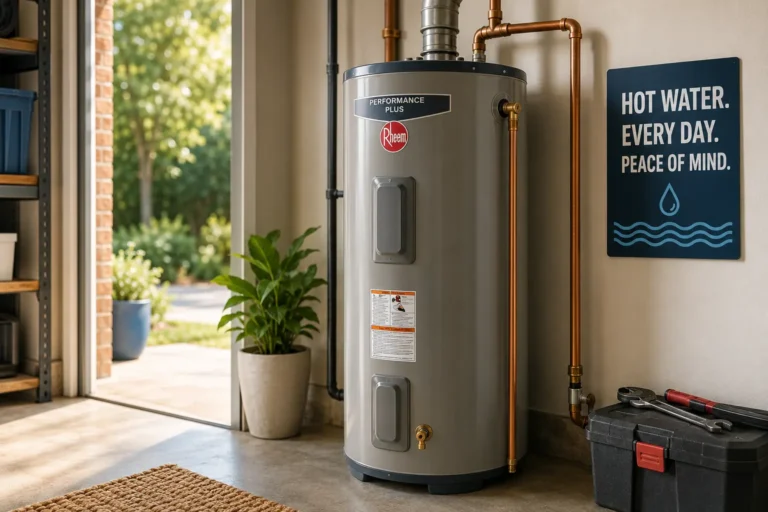
A leaking water heater is one of the most destructive emergencies because it holds 40–80 gallons of hot water under pressure.
Signs of a water heater emergency:
- Water pooling around the base of the unit
- Pressure relief valve blowing off (loud pop, steam)
- Rust-colored water (tank is corroding internally)
- Popping or rumbling sounds (sediment buildup overheating)
Local risk factor: Columbia’s hard water accelerates sediment buildup in water heaters, reducing lifespan and increasing failure risk.
Immediate action: Shut off the water supply to the heater. If it is a gas water heater, turn the gas valve to Pilot. If electric, shut off the breaker.
Gas Line Problems (Rotten Egg Smell)
Natural gas is odorless, but utility companies add mercaptan — a chemical that smells like rotten eggs or sulfur — as a warning agent.
What to do: If you smell gas inside your home, do not use any electrical switches, phones, or lighters. Evacuate immediately. Call Dominion Energy South Carolina’s gas emergency line at 800-815-0083 or 911 from outside your home.
Who handles gas leaks? Dominion Energy handles leaks outside the home or at the meter. A licensed emergency plumber handles gas lines inside the home after the meter.
Frozen Pipes (Before They Burst)
Frozen pipes are a unique emergency because the damage happens after they thaw.
Signs of frozen pipes:
- Frost on exposed pipes
- Only a trickle of water from faucets
- Unusually cold temperatures inside crawlspaces or basements
Local risk factor: In Lexington County and Richland County, many homes have crawlspaces with minimal insulation. Pipes in those areas freeze during sustained cold snaps.
What not to do: Never use a propane torch or open flame. Use a hair dryer, space heater, or warm towels.
Sudden Water Pressure Loss
If your shower suddenly feels weak — or water barely trickles from every faucet — you may have a main line leak or a slab leak.
Local risk factor: Red clay soil expands and contracts, putting pressure on copper pipes buried under concrete slabs. Over time, friction wears a hole in the pipe — a slab leak.
Signs of a slab leak:
- Warm spots on the floor
- Sound of running water under concrete
- Unexplained spike in your water bill
What to Do Before an Emergency Plumber Arrives
Waiting for a plumber can feel helpless. These five steps protect your home and save you money.
Step 1: Locate and Turn Off Your Main Water Shut-Off Valve
In most Columbia homes, the main shut-off valve is located:
- Near the water meter (usually at the street or front yard)
- In a mechanical room or closet
- In the crawlspace (older homes)
Turn the valve clockwise to close it. If your home has a ball valve (lever style), turn it perpendicular to the pipe.
Step 2: Turn Off Your Water Heater
Gas water heater: Turn the thermostat to Pilot.
Electric water heater: Shut off the dedicated breaker.
This prevents the tank from overheating or burning out heating elements when water is off.
Step 3: Open All Faucets
Open cold water faucets throughout the house to drain the system. This relieves pressure and reduces the volume of water that can leak.
Step 4: Move Furniture and Create Towel Dams
Move furniture away from wet areas. Use towels, blankets, or a wet/dry vacuum to contain water. If water is spreading, create a towel dam (tightly rolled towels in a line) to redirect flow.
Step 5: Take Photos for Insurance
South Carolina homeowners insurance typically covers sudden and accidental water damage (like a burst pipe) but not negligence (ignoring a slow drip for months). Take photos of the leak, the damage, and any temporary repairs you made.
How Fast Can Plumbing Damage Spread?
Plumbing damage is not linear; it accelerates over time. In the first hour, water saturates flooring and drywall.
| Time Elapsed | Damage Progression |
| 0–1 hour | Water saturates flooring and drywall |
| 1–4 hours | Water wicks up walls (capillary action), reaches electrical outlets |
| 4–12 hours | Subfloor and underlayment absorb water |
| 12–24 hours | Mold spores begin colonizing (EPA) |
| 24–48 hours | Permanent drywall damage, structural wood rot begins |
| 48+ hours | Category 2 water becomes Category 3 (biohazard) |
Local note: Columbia’s humid climate accelerates mold growth compared to drier regions.
Common Plumbing Emergencies During Columbia SC Storms
Columbia experiences summer thunderstorms, flash flooding, and occasional tropical storm remnants. During heavy rain, sump pump failure is a common emergency. If your sump pump fails during a storm, your basement or crawlspace can flood within hours. Signs of failure include the pump running but water not draining, the pump running continuously, or a stuck float switch. Prevention includes installing a battery backup sump pump before storm season.
Sewage backups after heavy rain are another local risk. During flash flooding, municipal sewer lines can become overwhelmed. If your home has a backwater valve, it should prevent sewage from entering. If not, you may experience a backup. The Gills Creek and Crane Creek watersheds are particularly prone to flash flooding. Homeowners in those areas should consider backwater valve installation.
How Much Does Emergency Plumbing Service Cost?
Understanding pricing eliminates the fear of surprise bills. In Columbia, SC, the typical dispatch fee or trip charge ranges from $75 to $150. Hourly labor during standard hours runs $100 to $200. After 5 PM, hourly labor increases to $150 to $250. On weekends and holidays, hourly labor can reach $200 to $350 or more. A burst pipe repair including parts typically costs $300 to $1,200.
A sewer line cleanout using an auger costs $250 to $500. Emergency water heater replacement runs $800 to $1,800. Gas leak detection and repair costs $200 to $800. Most South Carolina homeowners insurance policies cover sudden and accidental water damage, such as water that damages walls and floors, but may not cover the repair to the pipe itself unless you have a specific endorsement. Call your agent to verify your coverage before an emergency happens.
Preventing Future Plumbing Emergencies
Before winter, which means October through November in Columbia, you should insulate pipes in crawlspaces and exterior walls, disconnect garden hoses and cover outdoor spigots, and drip faucets overnight when temperatures drop below 25 degrees Fahrenheit. Before storm season, which is April through May, test your sump pump by pouring water into the pit, install a battery backup system, and clean gutters and downspouts away from your foundation.
Year‑round maintenance includes locating and testing your main water shut‑off valve, replacing angle stops every 15 to 20 years, having your sewer line inspected with a camera if you live in Shandon, Forest Acres, or Elmwood, and monitoring your water bill for unexplained spikes. Use Columbia Water’s Eye on Water app to detect leaks early. These small investments of time can save you thousands of dollars and hours of stress.
Frequently Asked Questions (FAQ)
Is a slow drain an emergency?
No, not unless it is happening in every drain in your home. That suggests a main line clog, which can lead to a sewer backup. How long can I wait with a dripping pipe? If it is a slow drip from a faucet or showerhead, you can wait for regular business hours. If it is from a supply line or angle stop, call immediately.
Can a plumber come on a Sunday in Columbia?
Yes. Emergency plumbers operate 24/7, including Sundays, holidays, and overnight. Should I call a plumber or my landlord first? If you rent, call your landlord or property manager first. If they are unreachable, call an emergency plumber and document everything for reimbursement.
What is the emergency number for gas leaks in Columbia?
Call an emergency plumber at 111-111-1111 from outside your home. Do not call from inside if you smell gas. Does homeowners insurance cover emergency plumbing? It covers resulting water damage to walls, floors, and belongings but may not cover the pipe repair itself. Check your policy for water damage exclusion clauses.
Is a running toilet an emergency?
No, but it can waste hundreds of gallons per day. Schedule a repair within a week. How do I know if I have a slab leak? Signs include warm spots on the floor, the sound of running water under concrete, and a sudden spike in your water bill.
What should I do if my water heater is leaking from the top?
Leaks from the top usually come from the inlet or outlet connections. Try tightening them. If the tank itself is leaking, replace it immediately. Can frozen pipes thaw on their own without bursting? Sometimes, but the risk of bursting is high. Call an emergency plumber to safely thaw them with controlled heat.
Why does my water pressure drop when I flush the toilet?
That is normal in older homes with smaller supply lines. If pressure drops throughout the house simultaneously, call a plumber. What is the difference between a sewer backup and a clog? A clog affects one drain. A backup affects multiple drains and often involves sewage coming out of the lowest point, usually a tub or shower. Should I attempt to fix a burst pipe myself? Only if you can access it safely and have a pipe repair clamp. Otherwise, shut off the main water valve and call a professional.
How much does an emergency plumber cost in Columbia, SC?
In Columbia, you can expect a dispatch fee of $75–$150 plus hourly labor. During standard hours, labor runs $100–$200 per hour. After 5 PM or on weekends, rates rise to $150–$350 per hour. A burst pipe repair typically costs $300–$1,200, while a sewer line cleanout runs $250–$500. Most insurance policies cover resulting water damage but may not cover the pipe repair itself.
How do I know if I have a frozen pipe before it bursts?
Signs include frost on exposed pipes, only a trickle of water from faucets, and unusually cold temperatures inside crawlspaces or basements. In Columbia, overnight lows in the 20s can freeze pipes in uninsulated areas. A frozen pipe is a pre‑burst pipe. Do not use a torch or open flame to thaw it. Use a hair dryer or space heater, and call an emergency plumber to safely thaw the line.
When in Doubt, Make the Call
Plumbing emergencies are stressful, expensive, and inconvenient. But waiting too long turns a stressful situation into a catastrophic one.
You now know exactly when to call an emergency plumber — and when you can safely wait. You have a triage system. You know how to shut off your water. You understand the unique risks that Columbia, Richland County, and Lexington County homeowners face, from red clay soil to Orangeburg pipe to freeze-thaw cycles.
But here is the most important thing to remember:
If you are reading this article while standing in water, smelling gas, or watching sewage rise in your tub — stop reading. Call a licensed emergency plumber right now.